
What is brand strategy and why does it matter for founders?
Complete answers to the most important questions about brand strategy for founders who want to understand the work before investing in it.
What is brand strategy?
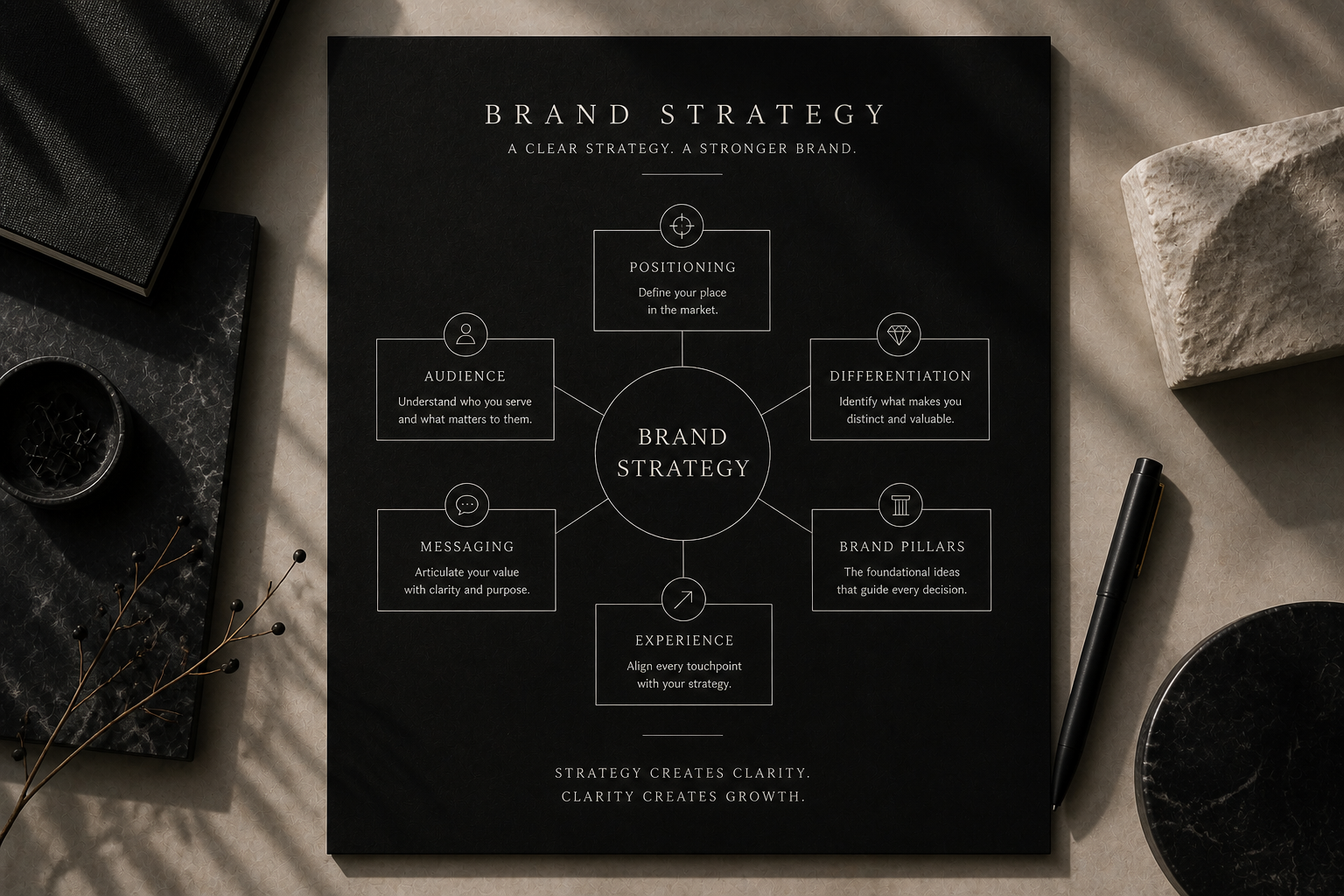
Brand strategy is the set of decisions that determine how a business is positioned in its market, how it communicates its value, who it is built for, and how it is perceived by the people it is trying to reach. It is not a logo, a color palette, or a tagline; those are expressions of brand strategy, not the strategy itself. Brand strategy is the architecture underneath the visible brand: the positioning logic, the audience definition, the narrative framework, and the messaging system that makes every other brand decision coherent.
Why does brand strategy matter for founders?
For founders, brand strategy is the difference between a business that grows through clarity and one that stalls through confusion. When a brand communicates precisely who it serves, what it does differently, and why it matters, the right clients find it more easily, trust it more quickly, and are less likely to need convincing. When the brand is unclear, founders spend more time explaining, more time on calls that don't convert, and more time competing on price instead of value. Brand strategy creates the conditions that make growth possible without requiring the founder to compensate for it through effort alone.
What does brand strategy include?
A complete brand strategy includes market and competitive positioning, audience definition and refinement, core narrative development, messaging architecture, offer language, and voice and tone direction. It also includes a visibility strategy: a plan for how the brand will be found and recognized in the places that matter most to the target audience. At One Quiet Morning, brand strategy is always developed alongside identity design, because the two inform each other in ways that produce stronger outcomes than either produces alone.
What is the difference between brand strategy and brand identity?
Brand strategy is the thinking that determines what a brand should be and how it should be understood. Brand identity is the complete visual and verbal system of that thinking: the logo, color system, typography, imagery style, and visual language that communicate the strategy at a glance. Strategy without identity is a document. Identity without strategy is decoration. The strongest brands are built when both are developed together.
How is brand strategy different from marketing?
Brand strategy defines what a business is and how it should be understood. Marketing uses that definition to reach the right audiences. Strategy comes first: without it, marketing has nothing coherent to amplify. Many businesses invest in marketing before the brand strategy is clear and find that results are inconsistent because the message changes depending on the channel, campaign, or day.
When does a business need brand strategy?
Brand strategy is most urgently needed when a business has real traction but inconsistent results — when the work is strong but the brand doesn't communicate that clearly, when leads come in but don't convert at the expected rate, or when the business has evolved but the brand still reflects where it started. It is also essential at launch for founders who want to build correctly from the beginning rather than correct a misaligned brand later.
How long does brand strategy take?
A focused brand strategy engagement like a positioning intensive typically takes one to two weeks. A complete brand development engagement through the One Quiet Morning Process — covering strategy, identity, web, and visibility — runs four to ten weeks depending on scope.
What is the One Quiet Morning approach to brand strategy?
One Quiet Morning approaches brand strategy as an integrated discipline — developing positioning, messaging, visual identity, web presence, and visibility as one coherent system. The studio was built on the conviction that strategy and design are the same decision expressed in different forms, and that brands built with that integration hold together in ways that brands assembled from separate vendors rarely do.